
Before Algebra Had a Name
Algebra was a word that has intimidated me since I was a mtoto (child). I was always fairly competent with arithmetic and for the longest time I thought that’s all mathematics was about, because that’s all we seemed to do in school. Then as I got further into high school I began seeing equations that contained letters instead of numbers. Well, that was it for me! I never ventured down that road, I got my C grade at GCSE and left maths for good.
Fast forward some decades and I’m a father. One day my children will come across algebra eventually. And I need to be ready to help guide them through and not follow in my footsteps!
One thing that might’ve helped the schoolboy me is having the knowledge that Africans were among the first to practice and record algebraic operations.
Waaty before Pythagoras, Plato, Aristotle and co, in the land of Kemet (modern day Egypt) in the Nile River Valley, scribes were writing and working through equations that involved unknown quantities. This is one of the fundamental concepts of algebra.
One of the clearest examples comes from a document known as the Rhind Mathematical Papyrus, dating to around 1650 BCE (c.3,600 years ago). This papyrus contains dozens of problems that today we’d recognise as algebraic.
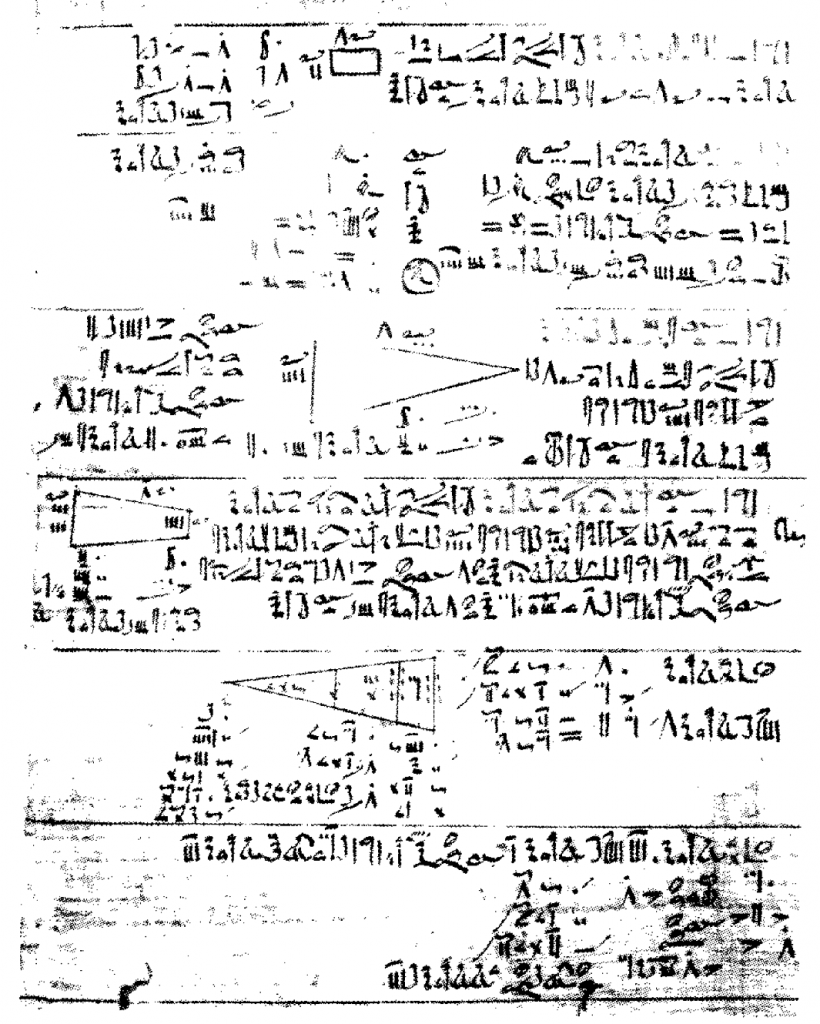
The “aha” and the Eye of Horus
Kemetic algebra used terms like “aha”, meaning “quantity”, to represent unknown values. For example, one problem might say “aha and its seventh part together make 19. What is the quantity?” This is essentially the equation x + x/7 = 19. The method used to solve it involved logical steps and mathematical structure.
This papyrus shows that In Kemet, mathematics was woven into daily life. Algebraic thinking was applied to architecture, agriculture, trade, and timekeeping.
Learn More
The Algebra of Ancient Egypt:
https://www.math.buffalo.edu/mad/Ancient-Africa/mad_ancient_egypt_algebra.html
Pingback: Teach children to be Algebraic Thinkers -
Pingback: For Black children, Knowledge of Self must come before "The Talk" -
Pingback: The Ishango Bone. More evidence of Africa's ancient Mathematical heritage -