

What’s 9 × 6? You might know the answer straight away, it’s 54. But how did you come to this figure? Maybe you dipped into your memorised 9 times table, or 6 times table. Up until very recently, I assumed that because I have never really memorised many times tables, that I didn’t have a maths mind. But in this article, I’ll show you how all of us can employ flexible approaches to solve problems like this.
Let’s say you don’t know your 9 or 6 times tables. That’s no problem. You probably do know your 10 times table right? 10, 20, 30, 40, etc. Here’s the thing, 9 is just one less than 10. The expression 9 x 6 really means “nine groups of six” or “six groups of nine.” We know that 10 x 6 or “ten groups of six” is 60. To find out what nine groups of six is, we just need to subtract 6 from 60. This gives us 54.
It’s the same with adding. What’s 28 + 89? That’s a bit clunky. But you can make the numbers friendlier. If you add 1 to 89, you get 90. Then if you take 1 from 28, you get 27. So now we need to do 90 + 27 which looks much easier right? It’s 117.
In both of these examples, you can do them the other way round. So for 28 + 89, you could add 11 to 89 to get 100, then take 11 from 28 to get 17 and then add them: 100 + 17 = 117. Either way, you break a complicated-looking problem into a much simpler one.
Maths Is About Making Connections
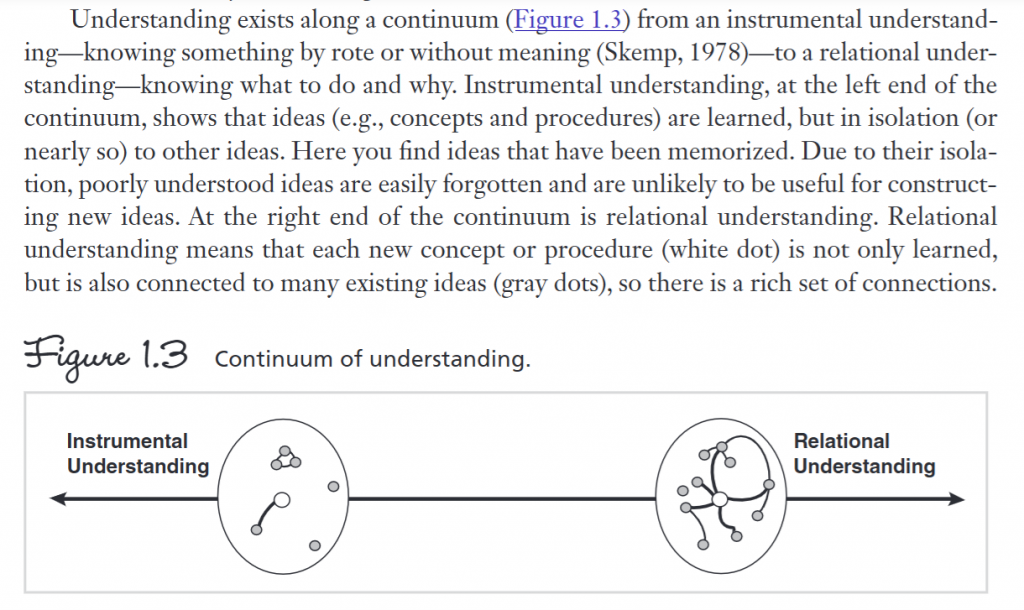
Good maths isn’t about remembering a hundred different facts. It’s about spotting relationships between numbers and being able to use this knowledge. If you can use what you already understand, you can find out what you don’t yet understand. This learning strategy is called constructivism and is explained in Teaching Student-Centered Mathematics by Van de Walle and co thusly:
Counting Is Harder Than You Think
Going back to our arithmetic problems, one thing I’ve realised that counting is actually very hard. In the context of an arithmetic problem, relying only on counting will make things much slower and harder for learners.
Let’s go back to 9 + 8. To find the sum, you could count up – 10, 11, 12… all the way up to 17. That’s a lot of steps. Very early learners will of course begin with this strategy because it’s the most obvious. But it’s essential that they move on from this.
One way I did this with my children is by focusing on doubles facts. Once a child is fluent with doubles facts up to 10 (i.e. 1 x 2 is 2, 2 x 2 is 4, etc), they can bring their knowledge to 8 + 9. They know that 8 + 8 makes 16, so the sum of 9 + 8 must be one more because 9 is one more than 8. These strategies are much faster and use far less mental effort than counting.
Help Children Think Flexibly
When dong arithmetic exercises with children, we should encourage them to spot patterns and call on their previous knowledge. We can prompt them with statements and questions like:
- What number is 9 close to?
- Can you get to an easier number to help?
- Can you break the number into smaller chunks?
- What would happen if you changed it slightly?
Gradually, children will start to build their flexibility with numbers. They’ll learn that there are many different strategies they can use to work through a problem. They’ll become much more engaged in the process of searching for ways through mathematical exercises. And this can only be good news for them as they develop into confident, independent mathematical thinkers.
Try it at home and watch your child rise, just like Imhotep!


This article delivers a refreshing, down-to-earth approach to making math more accessible. The author breaks through the idea that math must be intimidating and instead emphasizes practical habits, mindset shifts, and confidence-building strategies. It’s an empowering read that reminds us math is not about perfection—it’s about steady growth and real-life usefulness.
[…] encourages us to build knowledge by linking and layering information over time. I’ve written elsewhere about how a constructivist approach can make mathematics much easier, for example. When a child […]