
Light and Colour: What We Really See
When we see something that is dark, it’s understandable that we assume that thing has no light “in it.” Conversely, when we see brightly coloured things – we assume they are full of light. But if you think about how light actually works and how it interacts with matter – we can say that dark objects are actually full of light, while light things have very little light. Let’s dig into this.
Optics (the physics of light)
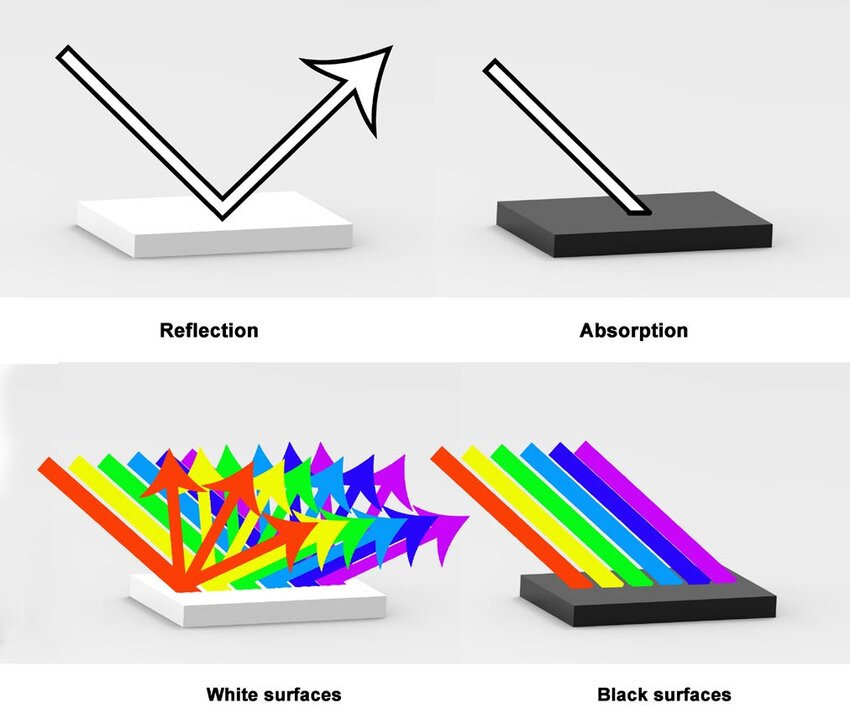
Light is composed of quantum entities called photons which act as both particles and waves (but that’s a story for another time when we start getting into quantum physics). When we look at an object, the colour the object appears is determined by the photons which have bounced off the object, into our eyes.
If an object appears light coloured, this is because all or most of the photons that reached that object bounced off its surface rather than being absorbed. Our eyes receive those reflected photons and thus we perceive the object as light in colour. What about objects that appear darker? Well, instead of reflecting light, these objects absorb most of the light that shines on them. So our eyes can’t perceive much light, which is why the object appears dark.
Melanin and the Science of Skin
This brings us to skin. Eumelanin is the complex molecule that is responsible for the deep brown and black tones in human physiology. The higher the quantity of eumelanin in a person’s skin or hair the more light that skin absorbs.
Eumelanin is found in epidermis which is the outermost layer of our skin, and it has a unique ability to absorb a wide range of light. It is especially effective at soaking up ultraviolet (UV) light as well as violet, blue, and other high-energy wavelengths.
By the way, you might be wondering what eumelanin actually does with all those photons. When eumelanin absorbs the light into its highly complex molecular structure, it changes that light into different forms of energy. Much of it is converted into heat energy and dissipated. It’s possible that eumelanin also converts light into different forms of energy, such a electrical energy. This is still a very new area of research as of 2025 so if you’re reading this years into the future, you probably know a lot more than I did here!
Full of Light, Not Lacking It
So my working concept about dark objects and especially dark skin is that they are actually full of light, from a scientific perspective. Black and brown skin absorbs and processes light constantly, converting this light energy into other forms, which we’re only just beginning to learn about. In contrast, very light-coloured skin reflects most light and absorbs very little. While it might look bright to us, in reality, less light is being held within it.