
What is Eumelanin?
Most of us have heard of melanin, the substance that gives our skin, eyes and hair their brown and black colours. But there are actually several kinds of melanin that exist in nature. The one that to gives to the darker appearance is called eumelanin. The name eumelanin comes from two Greek words, “eu” meaning good or true, and “melas” meaning black. Among the types of melanin in the body, eumelanin is the only one that absorbs light energy and transforms it in a way that supports health and resilience.
Biological Dark Matter
Eumelanin is a deep brown to black molecule (lots of atoms joined together). It’s highly efficient at absorbing Ultraviolet (UV) radiation and converting it into harmless heat. This energy transformation helps protect skin cells from stress and keeps the body’s systems in balance. In this way, eumelanin works like a built-in energy converter (aka transducer) that helps the body regulate and optimise the powerful effects of the sun, the main source of energy on Earth.
By contrast, another molecule called pheomelanin, which appears reddish-yellow, behaves very differently. It doesn’t absorb UV energy well and can even generate harmful byproducts when exposed to sunlight. In fact, pheomelanin offers little to no protection and may actually increase the risk of cellular damage over time. It lacks the key transducing properties that make eumelanin so valuable to health.
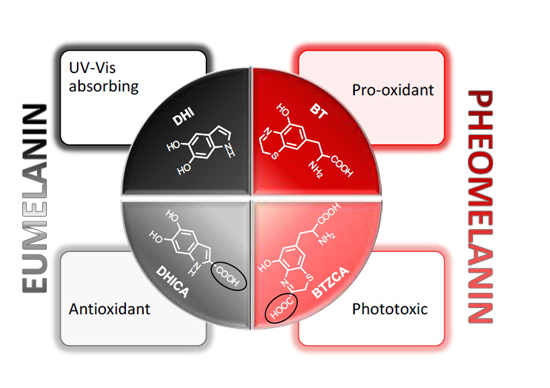
Comparing eumelanin and pheomelanin. Source: https://www.mdpi.com/1422-0067/17/5/746
Here’s where things get especially fascinating. Eumelanin shows properties similar to a semiconductor, a material that can conduct energy in controlled ways, like in solar panels or electronics. This means eumelanin doesn’t just absorb energy; it helps manage and redistribute it, making it even more valuable to the body.
Eumelanin and Physical Features
Red hair can contain high levels of pheomelanin, but generally, all types of skin contain a higher proportion of eumelanin than pheomelanin.
The levels and distribution of eumelanin are genetically determined and play a key role in determining a person’s skin, eye, and hair colour. Higher concentrations of eumelanin in the skin result in deeper, darker tones, while lower levels produce lighter complexions. In the eyes, a greater amount of eumelanin in the iris leads to brown eyes whereas a lack of it allows other colours to dominate, resulting in blue or green eyes. Similarly, high eumelanin levels in our hair create black or dark brown hair, moderate levels produce lighter brown shades, and very low levels lead to yellowish or blonde hair.
Pingback: Have You Ever Wondered What Is Light, Actually? -
Pingback: Why Non-African People Have Neanderthal DNA -
Pingback: Biophotons: The Invisible Light of Life -
Pingback: Ultraviolet Light is much more than just Dangerous Rays -
Pingback: Melanin in the Ear? Hearing, Balance and Protection. -
Pingback: For Black children, Knowledge of Self must come before "The Talk" -
Pingback: Why Dark Skin Is Full of Light! -
Pingback: Spectroscopy. How Light Tells Us What Things Are Made Of -